

Most parents are familiar with reading comprehension: a child reads a passage and answers questions about it. But what happens when the information is spread across several different sources; perhaps a written passage, a map, a table and a set of notes? Some 11+ assessments use tasks like these to explore a broader set of skills. Described as Creative Comprehension, they ask children to bring information together, make connections and work out what it means.
What is creative comprehension?
Creative Comprehension is not a feature of every 11+ exam. It is included in some assessment formats, including Part 2 of the Quest Assessment used by a growing number of schools.
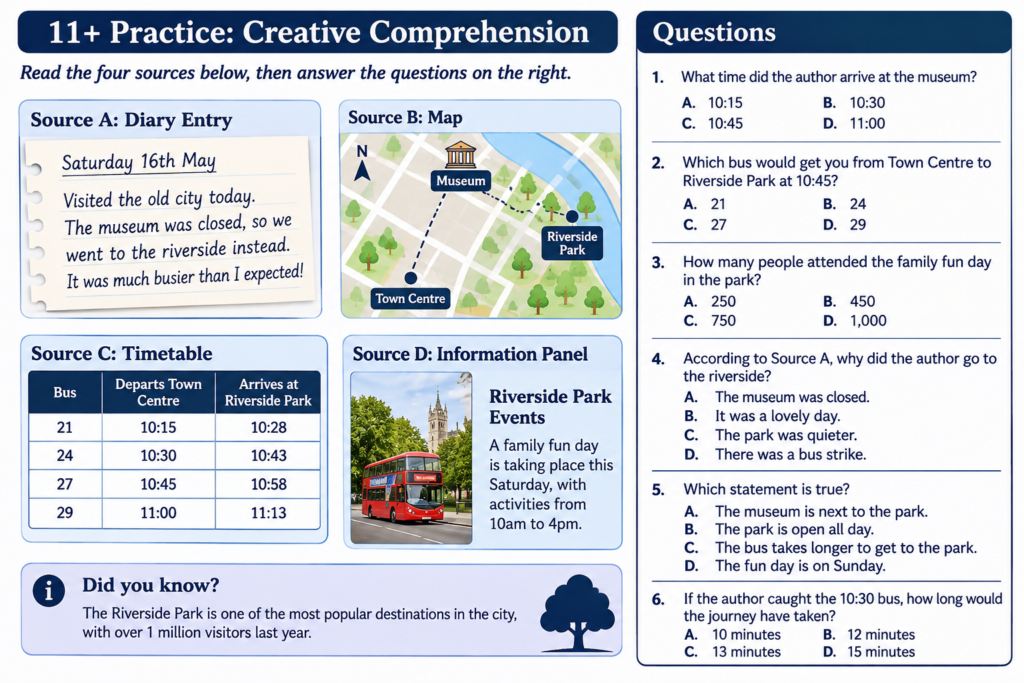
Rather than relying on a single passage, a task may present information in several forms, such as:
- Written passages or diary entries.
- Maps and diagrams.
- Tables, charts or graphs.
- Pictures, symbols or coded information.
The child must interpret the information, identify relevant details and combine clues to answer questions.
For example, a child might read a short diary entry, study a map and use a timetable to work out where someone went and when they arrived.
The challenge is not simply reading each source. It is understanding how the sources fit together.
Which skills are being tested?
Creative Comprehension can draw on several important skills.
Inference: working out what is suggested rather than directly stated.
Selecting relevant information: identifying which details matter to the question and which can be ignored.
Connecting ideas: combining clues from different sources to reach a conclusion.
Interpreting visual information: understanding what a map, chart, table or diagram communicates.
Logical thinking: checking that an answer makes sense when all the available information is considered.
These skills overlap with English, Maths and Reasoning. Strong reading skills help children understand written information, while numerical confidence can help them interpret tables and data. Reasoning helps them connect clues and reach conclusions.
 How can you practise creative comprehension at home?
 How can you practise creative comprehension at home?
The good news is that you do not need to recreate an exam paper every evening. Small, everyday activities can help children become more confident at interpreting information.
- Ask questions about everyday information.
Look at a timetable, a map, a recipe or a shopping list together. Ask your child to find specific information and explain how they know the answer.
- Encourage inference when reading.
Instead of asking only what happened in a story, ask questions such as:
- How do you think the character is feeling? What makes you think that?
- What can we work out, even though the writer has not told us directly?
- Which detail gives us the biggest clue?
Encourage your child to support their answers with evidence rather than guess.
- Combine different sources.
Give your child a simple map and a timetable, or a short description and a picture. Ask a question that requires them to use both.
- Ask them to explain their thinking.
When your child answers, ask which clues they used and how those clues helped them reach their conclusion. This helps make their reasoning more deliberate.
Is creative comprehension part of every 11+ exam?
The short answer is no. The 11+ is not one standardised test with an identical format across all schools.
Some schools use assessments with dedicated Creative Comprehension sections. The Quest Assessment includes this type of task. Always check the current admissions guidance for the schools you are considering before choosing preparation materials.
At Hyde Tutoring, we focus on English, Maths and Reasoning. Helping children read carefully, interpret information and explain their thinking supports these broader learning skills, not just exam preparation.
Creative comprehension is about making connections. Children need to look beyond individual facts, notice useful clues and bring information together to understand the bigger picture.