


The 11+ can feel complicated for parents. Different schools use different tests, preparation materials and assessment formats, and they do not always test the same skills.
Alongside familiar subjects such as English and mathematics, some entrance assessments now include tasks designed to explore how children think, recognise patterns and solve unfamiliar problems.
So, what does this mean for your child?
What is the 11+?
Selective schools, including grammar and independent schools, use the 11+ as an entrance assessment to determine which children will be offered places.
Depending on the school and assessment, children may be tested in:
- English: reading comprehension, vocabulary, grammar and writing-related skills.
- Maths: numerical skills, calculations and mathematical problem-solving.
- Verbal reasoning: using words, language and logical relationships.
- Non-verbal reasoning: recognising patterns, shapes and visual relationships.
Some assessments also include additional problem-solving tasks. Different schools may have varying formats, so verify each school’s 11+ requirements for your child’s applications.
What are 11+ puzzles and problem-solving questions?
Puzzles and problem-solving tasks aim to assess how children approach a challenge, rather than simply whether they can recall a fact or apply a familiar method.
A question might involve numbers, shapes, sequences, spatial relationships or logic. Children may need to identify a rule, test an idea, work through several steps or change their approach when something does not work.
For example, a child might be asked to identify the missing shape in a sequence or work out a number pattern using clues.
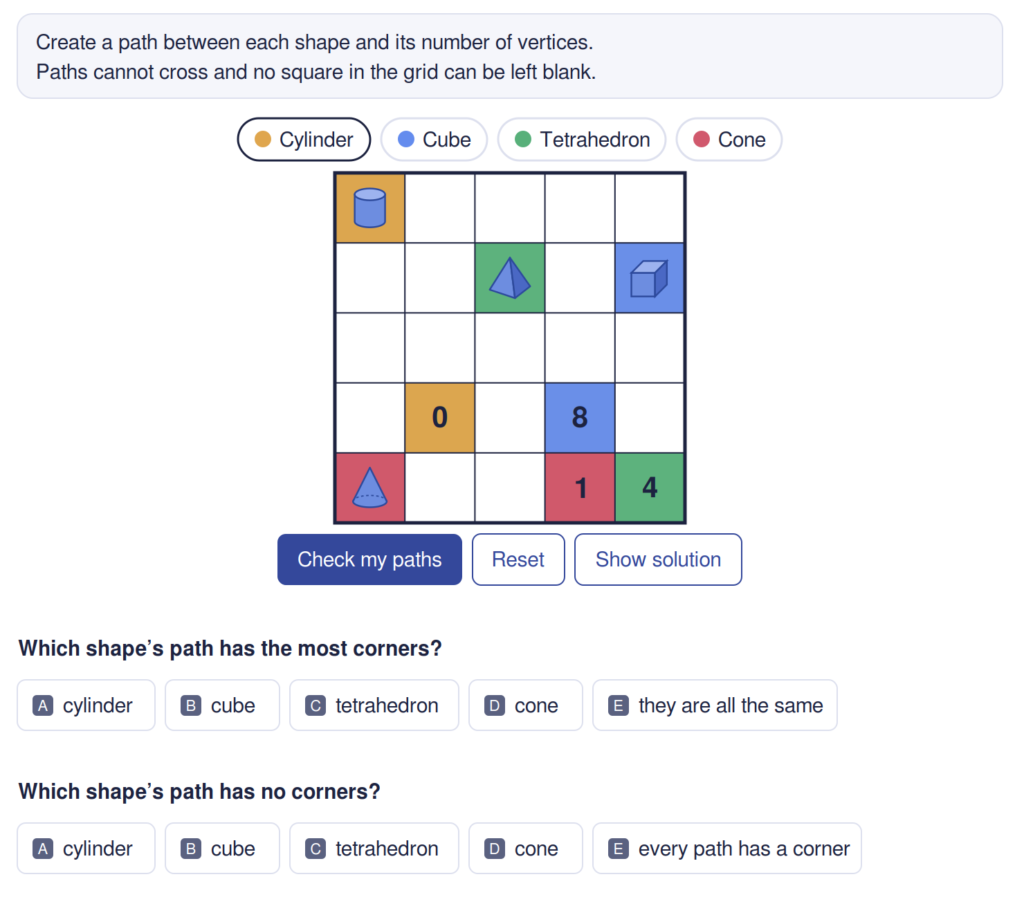
These questions can feel unfamiliar, particularly if a child is used to practising questions that follow a predictable format.
The important skills include:
- Recognising patterns and relationships.
- Applying logic to new situations.
- Breaking a larger problem into smaller steps.
- Trying different approaches when the first attempt fails.
- Explaining how they reached an answer.
How can you develop these skills at home?
You do not need a cupboard full of specialist 11+ resources. Everyday activities can encourage the same habits of thinking.
Try number and shape puzzles. Write a sequence such as 3, 7, 11, 15 and ask your child what comes next. More importantly, follow up by asking how they worked it out. You could also draw repeating patterns, use pencils to create shapes, or try simple number challenges.
Play strategy games together. Noughts and crosses, Connect 4, chess and draughts all encourage children to plan ahead, anticipate another player’s moves and consider different possibilities. As you play, ask questions such as, “What do you think will happen next?” or “Why did you choose that move?”

Ask “How do you know?” When your child solves a problem, invite them to explain their reasoning. If learners get stuck, ask them what they have tried and what they could try next.
Make mistakes useful. If an answer is incorrect, resist the urge to give the solution immediately. Help your child identify where their reasoning changed direction and explore another approach.
These activities support reasoning alongside the maths and English skills children may already be developing.
Does every child need to practise these questions?
Not necessarily. Some schools use assessments that include dedicated puzzles and problem-solving sections; others do not. The format and emphasis may vary even when these tasks are included.
Before buying practice papers or beginning intensive preparation, check the current admissions information for your target school. Familiarity with the relevant question types can help, but preparation should be appropriate to the assessment your child will actually take.
Everyday activities help develop these skills, from playing games to talking through a tricky problem together. The aim isn’t always to find the answer straight away, but to help children become more comfortable exploring ideas, explaining their thinking and trying a different approach when something doesn’t work.
How can tutoring support your child?
Preparing for the 11+ is not just about practising questions. It is also about understanding how different question types work, developing effective strategies and building confidence when faced with something unfamiliar.
A tutor can help identify areas where a child may need extra support, guide them through different approaches to problem-solving and help them understand not just what the answer is, but why it is correct.
The right preparation will depend on the schools your child is applying to and the assessments they use. Focusing on the relevant English, Maths and Reasoning skills can help children approach their preparation in a structured and purposeful way.